

Before the first whistle blows, the tone of the entire match is already being set. The warm-up is not just about jogging and stretching; it’s the first chapter in the story your team will write that day.
1. The Purpose Behind the Warm-Up
Every warm-up has three interconnected goals: to prepare the body, to awaken the mind, and to establish the team’s tactical identity before a ball is kicked. At the youth level, it’s an opportunity to educate players about their own readiness — physically, technically, and mentally. The best teams hit their stride early because they have learned how to “switch on” before the game begins.
An effective warm-up primes the energy systems, sharpens the neuromuscular system, and connects thought to action. It’s about raising the temperature — not just of the muscles, but of the mentality.
2. Mindset and Mental Activation
The warm-up starts in the mind. Too often, young players stroll through pre-match routines without purpose — chatting, half-focused, and mentally elsewhere. Coaches must set the tone immediately.
- Establish intensity and focus: From the first drill, players should be alert, moving with intent, and communicating.
- Use clear pre-match language: A short team huddle with confident reminders — “Be brave on the ball,” “Press together,” “Play forward fast” — connects the session to the team’s identity.
- Eye contact and body language: Encourage players to look each other in the eye, stand tall, and express energy. A player’s posture before kickoff often mirrors their first five minutes.
- Mental rehearsal: Ask players to visualize their first involvement — a tackle, a pass, a shot. Visualization builds confidence and readiness.
At this stage, the coach’s tone and energy are everything. Players mirror the emotional state of their leader. A calm but passionate coach transfers belief; a distracted or rushed coach can pass on anxiety.
3. Physical Preparation: Build, Don’t Burn
The physical warm-up must follow a progressive path — from light movement to match-speed actions — without overloading players.
Each phase serves a physiological purpose: increasing heart rate, loosening joints, activating key muscle groups, and sharpening reaction times.
Phase 1 – Mobilize and Awaken (5 minutes):
Gentle jogging, lateral movement, and mobility exercises such as hip circles, leg swings, and arm rotations. The aim is to “wake up” the body, not fatigue it.
Phase 2 – Dynamic Activation (5 minutes):
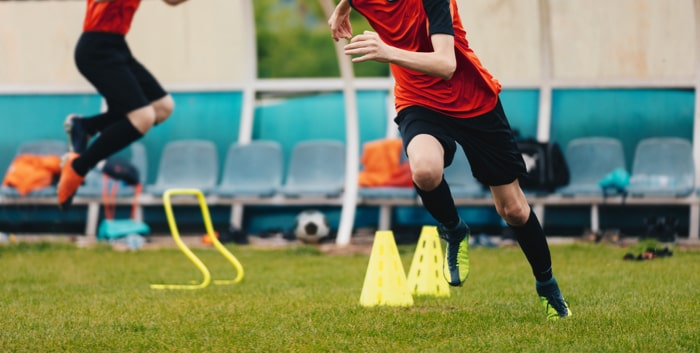
Incorporate dynamic stretches like high knees, heel flicks, skips, and lunges with rotation. Add controlled accelerations over 10–15 yards.
Phase 3 – Explosive Readiness (5–7 minutes):
Short sprints, fast feet ladders, quick changes of direction, and reaction races. Include ball work where possible — acceleration after a pass, or transition sprints after receiving.
By the end, players should feel light, fast, and engaged — not heavy or tired. Remember: a good warm-up should prepare, not punish.
4. Technical Activation: Touch, Decision, and Confidence
Once the players are physically ready, the session transitions to football-specific sharpness. Here, you connect movement with decision-making.
Use game-relevant drills:
- Passing and receiving in pairs: 1–2 touch, varying distances and surfaces.
- Rondos (3v1, 4v2): Builds quick thinking, awareness, and tempo.
- 1v1 duels: Encourages competitiveness and attacking mindset.
- Crossing and finishing: Ending with a goal-related activity instills confidence and rhythm.
The rule here is tempo and quality. Every touch should mimic match conditions — firm passes, quick decisions, and constant scanning. Avoid long queues or low-tempo drills. If players are walking between activities, they’re mentally switching off.
Coaches should challenge players to “train the brain” — for instance, using one-touch combinations with directional constraints (“play forward if you can”), encouraging scanning before every pass, and demanding communication at every stage.
5. Team Connection: Building Chemistry Before Kickoff
A team that warms up together plays together. The final 5–8 minutes should simulate match flow.
Use a short possession game or small-sided match (e.g., 5v5 with end zones).
The goals:
- Encourage communication and awareness.
- Reinforce tactical cues — pressing triggers, width in possession, or quick transitions.
- Promote shared energy and teamwork.
End the warm-up with a positive ritual — a huddle, handshake circle, or captain’s call. These small habits bond the group and help players transition mentally from training to competition mode.
6. The Science Behind Effective Warm-Ups
Research consistently shows that dynamic, game-related warm-ups enhance performance and reduce injury risk. The body’s neuromuscular activation improves — meaning reaction times shorten, passing accuracy increases, and overall coordination is sharper.
Moreover, a well-planned warm-up primes the energy systems: ATP-PC and glycolytic pathways are ready for high-intensity bursts, and the cardiovascular system efficiently delivers oxygen to working muscles.
The difference is visible: a team that’s been through a purposeful warm-up plays their first 10 minutes at full tempo while others are still finding their rhythm.
7. Coaching the Warm-Up Like a Pro
A common mistake is treating the warm-up as a routine rather than a session to coach. Even in warm-ups, the coach can subtly teach game principles:
- During rondos, emphasize pressing angles or passing lanes.
- During 1v1s, highlight body shape and defensive timing.
- During finishing, demand composure under pressure.
Each phase reinforces habits that appear in the match — intensity, awareness, and precision.
The warm-up is the final rehearsal before the live performance.
8. Common Mistakes and How to Avoid Them
- Too static: Long static stretches slow muscle readiness. Replace with dynamic mobility work.
- Too long: Over 25 minutes risks draining energy. Keep it sharp and progressive.
- No link to match plan: Warm-ups must reflect how you want to play. If you press high, include sprints and quick transitions.
- No emotional energy: Players take cues from the coach’s enthusiasm.
- Ignoring individual needs: Some players require more mobility or extra touches — personalize when possible.
9. Adapting Warm-Ups for Different Age Groups
- Under 8–10: Keep it fun and movement-based. Games like tag or mini races encourage natural agility and focus.
- Under 11–13: Introduce more structure — short rondos, passing combinations, and shooting.
- Under 14–16: Add tactical cues, team shapes, and game-speed drills.
- Under 17+: Focus on intensity, match-style tempo, and precise tactical rehearsal.
Adapt the complexity, not the energy.
10. The Psychological Edge
A well-delivered warm-up gives players confidence. It signals that the team is organized, purposeful, and ready.
Players feel prepared because the coach has guided them through a process of activation — body, mind, and ball. That psychological momentum often translates into the first goal or the first tackle won.
At elite level, players talk about “feeling right” before a game. That feeling isn’t luck — it’s preparation. It’s rhythm built from repetition and routine.
11. Key Takeaways for Coaches
- Treat warm-ups as coaching opportunities, not just preparation.
- Blend physical, technical, tactical, and mental elements.
- Match the intensity to the playing style and age group.
- Always end with energy, confidence, and togetherness.
When your team starts every match “in top gear,” it’s rarely an accident — it’s the product of a consistent, intelligent approach to pre-game preparation.
⚽ Coach’s Toolkit: Preparing Players to Start in Top Gear
1. Key Coaching Phrases (Language That Inspires and Directs)
Use these during the warm-up to set tone, focus, and intent.
They should be short, sharp, and emotionally intelligent — connecting physical actions with tactical and mental readiness.
Mindset & Focus:
- “Switch on early — be first to think, first to act.”
- “Play the way you want to start.”
- “Sharp feet, sharp minds.”
- “See it, say it, do it.”
- “Confidence through energy.”
- “Set your standard now.”
Physical & Technical Activation:
- “Build your speed — don’t burn it early.”
- “Crisp passes, bright eyes.”
- “Get your body ready for the game rhythm.”
- “Connect the touch, the voice, and the movement.”
Team Connection:
- “Talk, trust, and move together.”
- “Play with rhythm, play with purpose.”
- “Find each other early — feel the flow.”
- “Warm-up like a team that wants to win the first five minutes.”
💬 Coaching tip: The tone of your voice matters as much as the words. Positive, composed, and confident language promotes emotional control and focus.
2. Player Challenges (Engagement & Ownership)
Challenge players to own their preparation — making them think, adapt, and take responsibility for readiness.
Mindset Challenges
- “Can you start your warm-up at match intensity — not build into it?”
- “Set yourself a mental target: win your first duel, complete your first pass, make your first touch count.”
- “Can you be the loudest communicator in your group during warm-up?”
Technical Challenges
-
“In every passing activity, can you check your shoulder before you receive?”
-
“Count how many one-touch passes you can complete in 60 seconds.”
-
“Can your first touch always move you into space?”
Team Challenges
-
“Can your group complete 10 passes without losing tempo?”
-
“Score 3 quick goals in the final game before the whistle.”
-
“Encourage one teammate every minute — make someone else feel confident.”
🎯 Why this matters: Youth players often view warm-ups as routine. By adding challenges, you transform it into a competitive, thinking environment that mirrors match conditions.
3. Observation Tips (What Coaches Should Watch For)
Observation is where elite coaches separate themselves. The warm-up provides critical clues about players’ readiness — physical, mental, and emotional.
Use these cues to identify who is switched on and who may need a quick word or extra focus.
A. Physical Readiness
- Look for:
- Active body language — light on feet, shoulders open, posture upright.
- Sharpness in movements (no sluggishness or stiffness).
- Smooth acceleration and controlled deceleration in direction-change drills.
- Coaching Response:
- Encourage more energy with positive tone: “Great tempo, keep that rhythm!”
- Quietly check in with slower players — tightness might indicate nerves or fatigue.
B. Technical Readiness
-
Look for:
-
Quality first touches — firm, purposeful, and forward-thinking.
-
Players scanning before receiving — showing awareness and calmness.
-
Communication between teammates (verbal and visual).
-
-
Coaching Response:
-
Highlight good habits publicly — “Love that first touch, that’s game-ready!”
-
Gently correct sloppy technique: “Lock in early — first five minutes decide the tempo.”
-
C. Mental & Emotional Readiness
-
Look for:
-
Players engaging with teammates, encouraging each other.
-
Focused faces, consistent eye contact, limited distractions.
-
Positive reactions to mistakes — quick recovery, not frustration.
-
-
Coaching Response:
-
Build collective energy: “Everyone connected, everyone ready.”
-
Pull individuals aside for calm reminders — “Trust yourself, you’ve done the work.”
-
👀 Elite tip: The warm-up gives you your first tactical picture of the day. Are players sharp? Are combinations fluid? Adjust your pre-match talk based on what you see — not what you planned.
4. Progression Pathway (Adapting for Age and Ability)
U8–U10 (Foundation Phase)
-
Keep warm-ups playful — movement games, races, and fun competitions.
-
Focus on agility, coordination, and confidence on the ball.
-
Example: “Can you move like your favourite player for 20 seconds?”
U11–U13 (Youth Development Phase)
-
Add structure — rondos, directional passing, short-possession games.
-
Begin introducing tactical language (“create angles,” “open up the pitch”).
-
Encourage self-check: “How ready do you feel right now?”
U14–U16 (Competitive Phase)
-
Use game-speed drills — pressing triggers, quick transitions, finishing under pressure.
-
Link warm-up actions to match strategy (“press high,” “counter fast”).
-
Promote leadership — captains lead sections of warm-up.
U17+ (Performance Phase)
-
Treat warm-up as a tactical extension of match plan.
-
Include quick tactical rehearsals (pressing zones, defensive shape).
-
Focus on mental control, breathing, and confidence cues.
5. Game-Day Warm-Up Structure Template
Total Time: 20–25 minutes
Equipment: Cones, bibs, balls, mini-goals
| Phase | Duration | Focus | Example Activities |
|---|---|---|---|
| 1. Mobilize & Awaken | 5 min | Movement & mobility | Jog, skips, lunges, dynamic stretches |
| 2. Dynamic Activation | 5 min | Speed & agility | Short sprints, direction changes, reaction drills |
| 3. Technical Activation | 7 min | Ball control & decision-making | Rondos, 1v1s, passing circuits |
| 4. Finishing & Confidence | 4 min | Sharp execution | Shooting, combination play, mini goals |
| 5. Team Connection | 4 min | Communication & rhythm | 5v5 or 6v6 mini-possession game |
🧠 Elite coaching insight: Keep transitions between phases tight — no downtime. Every second of the warm-up builds momentum. Players should never stand still for more than a few seconds.
6. Reflective Prompts for Post-Game Discussion
Ask players short, reflective questions to build learning habits:
-
“What helped you feel ready for kickoff today?”
-
“Did our warm-up energy carry into the first five minutes?”
-
“What could you personally do better next time to prepare mentally?”
-
“How did the team’s talk and tempo affect your confidence?”
Encouraging players to reflect helps them understand that readiness is a trainable skill, not a mood.
7. Motivational Messages (Player-Focused)
Add these to team huddles, whiteboards, or your digital platform before games:
-
“Start fast. Stay smart. Finish strong.”
-
“Our energy is our first advantage.”
-
“Preparation isn’t about luck — it’s about control.”
-
“Be the first to think, the first to act, the first to win your duel.”
-
“The warm-up sets the tone. Let’s make ours unbeatable.”
💡 Pro coach insight: Motivation before a game should inspire confidence, not anxiety. Frame everything positively — focus on control, readiness, and unity.
8. Key Takeaways for Coaches
-
The warm-up is part of coaching, not separate from it.
-
Every element — physical, technical, mental, tactical — connects to match goals.
-
A great warm-up creates emotional energy and shared rhythm.
-
Observe, adapt, and personalize — readiness looks different for every player.
-
The first five minutes reflect the last five minutes of preparation.
9. Optional Interactive Team Challenge
Introduce this challenge across the season:
“The Fast Start Scoreboard”
-
Each week, rate the team’s first 10 minutes (1–10) based on intensity, communication, and focus.
-
If they start strong, they “win” the warm-up challenge.
-
Keep a visible scoreboard through the season — it motivates consistency and builds pride in preparation.
10. Final Word: Coaching Readiness
A coach who treats warm-ups as rehearsals for performance — rather than just routines — teaches players how to own their readiness. The most successful teams in world football don’t just have the best tactics — they have the sharpest starts.
They are switched on mentally, connected physically, and united emotionally before the whistle.
That’s the power of great coaching. And it starts before the game even begins.


Improve Your GameJust 1.99 p/m
Exclusive drills and sessions, get involved today!
- 100’s of Drills
- Coach to Camera Videos
- Sessions from Pro’s
- Industry Leading Advice
Final Thought
Warm-ups are often overlooked, but they are the bridge between preparation and performance. A well-designed warm-up transforms individuals into a connected, confident, and cohesive team — ready to dominate from the opening whistle.
The coach who masters this art doesn’t just prepare players to start fast; they prepare them to think fast, move fast, and play fast.
That’s what separates good teams from great ones — and good coaches from outstanding ones.

Cupello
UEFA B Coach, FA Level 3, FA Youth Modules 1, 2 and 3, Coerver Youth Diploma, SPAIN: Catalan Football Federation Smart Football, USA: United Soccer Coaches diploma. Sports journalist for the Sunday Mirror published author of several volumes of coaching books & international lecturer on soccer.