
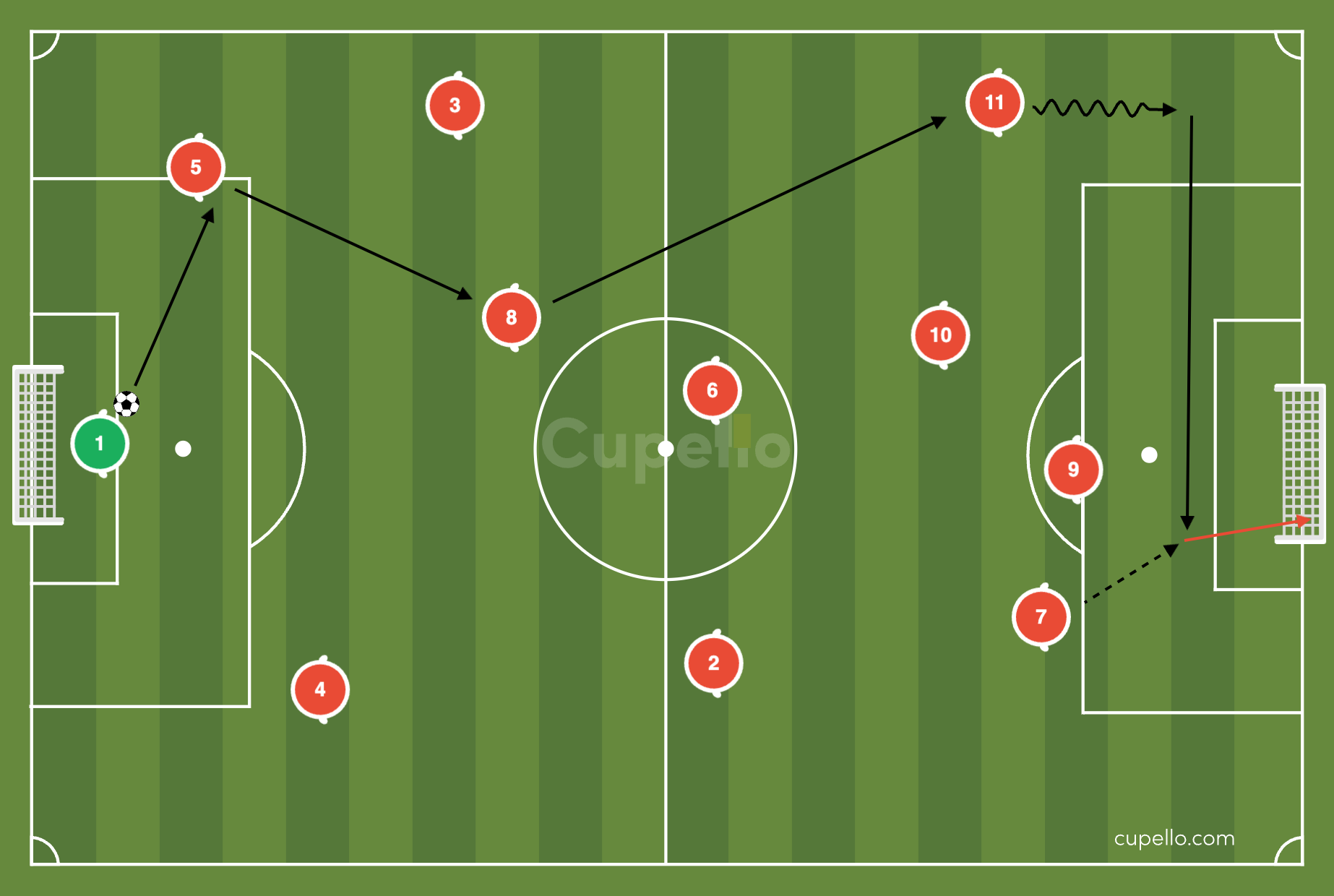
1. Create Width and Stretch the Defence
Use the full width of the pitch to make defenders cover larger distances. Wingers can stay wide to isolate full-backs, while central players occupy defenders and create space between defensive lines.
Coaching question:
“Can we make the pitch bigger before we try to make the attack smaller?”
2. Create 2v1s Around the Ball
Look for opportunities to overload defenders through combinations between wingers, full-backs, midfielders and forwards.
Use:
- Overlaps.
- Underlaps.
- Wall passes.
- Third-player runs.
- Rotations.
The objective is to make one defender responsible for two attacking threats.
3. Attack the Half-Spaces
Encourage players to recognise the spaces between full-back and centre-back. Receiving in these areas can create opportunities to turn, combine, cross or drive towards goal.
A player occupying the half-space can also draw defenders inside, potentially creating space for a teammate outside.
4. Rotate Positions
Don't allow attackers to become predictable. A winger can come inside, a midfielder can move wide and a forward can drop towards the ball.
The important principle is:
“If you leave your position, someone must recognise the space you create.”
Good rotation should create uncertainty rather than simply swapping positions.
5. Use the Forward as a Reference Point
The striker can provide a target for passes into feet, but shouldn't always remain between the centre-backs.
They can:
Drop → Receive → Set → Spin
This can create opportunities for midfielders or wingers to attack the space beyond.
6. Third-Player Combinations
One of the most effective ways to break a compact defence is to use a third player.
For example:
Midfielder → Forward → Third Player
The first pass attracts the defender, the forward sets the ball and the third player attacks the space created.
Encourage players to recognise this rather than memorising a fixed pattern.
7. Move Defenders Before Playing Through
Players should not always force the final pass immediately.
Use possession to move defenders from side to side. Once a defender steps out, another space may appear.
The attacking sequence becomes:
Move → Manipulate → Penetrate.
8. Create Different Runs
Avoid having every attacker run towards goal simultaneously.
Use a mixture of:
- Runs in behind.
- Checks towards the ball.
- Diagonal runs.
- Outside-to-inside runs.
- Inside-to-outside runs.
- Overlapping runs.
- Supporting movements.
Different runs force defenders to make decisions.
9. Attack the Box With Purpose
When the ball enters a crossing position, attackers should have clear responsibilities.
Encourage different players to attack:
- Near-post space.
- Central scoring areas.
- Far-post space.
- Cut-back areas.
- Edge-of-box positions.
Avoid five players running towards the same area.
10. Recognise the Cut-Back
When defenders retreat towards their own goal, the space around the penalty spot and edge of the box can become valuable.
Rather than always crossing towards the goalkeeper, attackers should recognise when a cut-back is available.
Coaching question:
“Where is the best place to deliver the ball for our teammate to finish?”
11. Combine Around the Box
Encourage quick combinations when defenders are compact.
Use:
Pass → Move → Receive
and
Pass → Set → Run
The speed of the combination can prevent defenders from resetting.
12. Encourage 1v1 Bravery
Creative possession must include individual responsibility.
When a winger receives isolated against a defender, encourage them to recognise the opportunity to attack.
They can:
Drive inside → Go outside → Combine → Cross → Shoot
The decision should depend on the defender's position.
13. Counterpress After Losing Possession
Final-third possession also requires preparation for transition.
If the ball is lost, the nearest players should react immediately and attempt to recover possession or delay the counter-attack.
This allows the team to attack with greater numbers without becoming unnecessarily exposed.


Improve Your GameJust 1.99 p/m
Exclusive drills and sessions, get involved today!
- 100’s of Drills
- Coach to Camera Videos
- Sessions from Pro’s
- Industry Leading Advice
The Final-Third Framework
Give players a simple attacking framework:
Stretch → Overload → Rotate → Penetrate → Create → Finish.
The aim isn't to make every attack complicated. The best final-third players recognise the picture quickly, combine when appropriate, attack when the opportunity appears and make the final action with conviction.

Cupello
UEFA B Coach, FA Level 3, FA Youth Modules 1, 2 and 3, Coerver Youth Diploma, SPAIN: Catalan Football Federation Smart Football, USA: United Soccer Coaches diploma. Sports journalist for the Sunday Mirror published author of several volumes of coaching books & international lecturer on soccer.