
What 7-year-olds can and can't do
Seven is a big year. Most children can now run, stop and change direction with reasonable control, and many are starting to dribble with their head up for a moment or two. U.S. Soccer's player development framework for this age describes them as able to coordinate full-body movements better, respond more quickly to what they see and hear, and start thinking about cause and effect. In practice, that means they can follow a two-step rule ("dribble, then stop the ball on red") and are starting to choose between dribbling and a short pass.
What they still find hard:
- Listening for long. Attention drops quickly when you stop the game to explain. Give one coaching point, demonstrate it, and get them playing again.
- Passing over distance. Passes beyond about 10 yards (9 m) rarely arrive. Keep areas small so a short pass is a real option.
- Team shape and positions. Expect "beehive" soccer, with everyone chasing the ball. That's normal. Rewarding a player who finds space on their own works better than assigning positions.
- Losing and waiting. Elimination games and long queues lead to tears or chaos. Design games so knocked-out players rejoin quickly.
- Using the weaker foot. Most will avoid it unless the game rewards it. Offer bonus points for weaker-foot goals.
The framework's advice to coaches is simple and worth following: one player, one ball; short instructions in the child's language; specific praise; and activities where players succeed and score lots of goals.
How to run a 60-minute session
Sixty minutes works well for 7-year-olds if the hour is broken into short games with water breaks between them. If your group struggles to last, cut the middle game and keep the match at the end.
| Time | Activity | Purpose |
|---|---|---|
| 0-5 min | Arrival: free dribbling or 1v1s with whoever is there | Touches straight away, no waiting for late arrivals |
| 5-15 min | Warm-up game with a ball each (Traffic Lights or Copy the Coach) | Movement, ball control, listening |
| 15-17 min | Water break | Reset attention |
| 17-30 min | Skill game 1 (Sharks and Minnows or Gate Dribbling) | The session theme, e.g. dribbling and turning |
| 30-40 min | Skill game 2 (1v1s, Numbers Game or Knock Down the Cones) | Same theme with an opponent or a goal |
| 40-42 min | Water break | Pick teams for the match |
| 42-57 min | Small-sided games: 3v3 or 4v4 on small fields | Play the real game; let them solve problems |
| 57-60 min | Huddle: one question, one shout-out, high fives | End on a positive note |
Pick one theme per session (dribbling, turning, shooting or 1v1 defending) and choose games that fit it. Repeating a favorite game week to week is fine. Kids this age like knowing the rules, and you get more playing time because you're not explaining something new. If your group is ready for more, try the games in our U8 soccer drills.
10 fun soccer drills for 7 year olds
Every drill below works with 8 to 12 players. With more players, run two areas side by side and ask a parent to watch one.
1. Traffic Lights
- Area: 20 x 20 yards (18 x 18 m) square marked with cones.
- Players: the whole group, one ball each.
- Equipment: 4 corner cones, a ball per player.
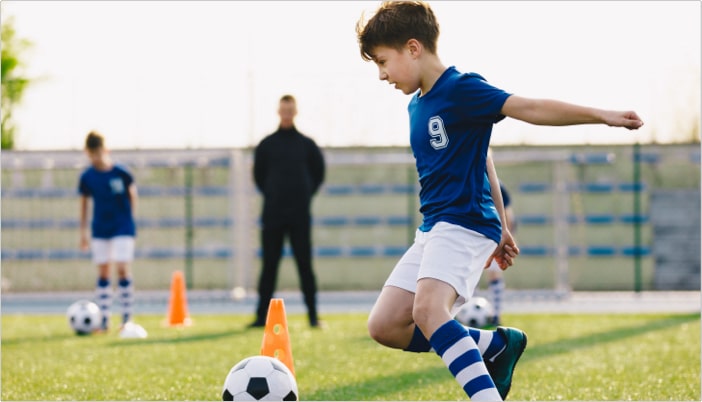
- How it runs: Players dribble anywhere in the square. Call "green" for normal dribbling, "yellow" for slow dribbling with tiny touches, and "red" for stopping the ball dead with the sole of the foot. Play 60-90 seconds, rest, repeat.
- Coaching points: small touches so the ball stays close; look up to avoid crashes; stop the ball with the sole, not by trapping it with the shin.
- Progression: add "purple" (turn and go the other way) and "blue" (dribble with your weaker foot only). Let a player be the caller.
2. Sharks and Minnows
- Area: 20 x 25 yards (18 x 23 m).
- Players: 2 sharks without balls; everyone else is a minnow with a ball.
- Equipment: 4 cones, bibs for the sharks.
- How it runs: Minnows start on one end line and try to dribble to the other end without a shark kicking their ball out of the area. A minnow who loses their ball does five toe taps on the sideline and then rejoins, so nobody sits out.
- Coaching points: keep the ball on the side away from the shark; change speed when a shark gets close; head for the gaps, not straight at a defender.
- Progression: minnows who lose their ball become sharks, until one minnow is left. Swap who starts as shark every round.
3. Gate Dribbling
- Area: 25 x 25 yards (23 x 23 m) with 8-10 gates scattered inside. Each gate is two cones about 1 yard (1 m) apart.
- Players: whole group, one ball each.
- Equipment: 16-20 cones, a ball each.
- How it runs: Players dribble through as many gates as they can in 60 seconds, counting out loud. They can't go through the same gate twice in a row.
- Coaching points: look up to find a free gate; slow down just before the gate and speed up after it; use both feet.
- Progression: pairs with one ball, where one dribbles and one defends; the dribbler scores by getting through a gate. Swap after 45 seconds.
4. Treasure Hunt

- Area: 20 x 20 yards (18 x 18 m) with a 3-yard (3 m) "treasure" circle in the middle and a small home base in each corner.
- Players: 4 teams of 2-3.
- Equipment: 12-15 balls in the middle, cones for the bases.
- How it runs: On "go", one player from each team runs to the middle, dribbles one ball back to their base, and tags the next teammate. After 90 seconds, count the balls in each base.
- Coaching points: sprint to the ball, control it before you set off, and dribble it back. No kicking it home.
- Progression: when the middle is empty, players may steal from other bases. Bases can't be defended.
5. Pass Through the Gate

- Area: 20 x 20 yards (18 x 18 m) with gates 2 yards (2 m) wide.
- Players: pairs, one ball per pair.
- Equipment: 12-16 cones, half as many balls as players.
- How it runs: Partners stand on opposite sides of a gate, 5-8 yards (4.5-7 m) apart, and pass through it. Each pass through scores a point. After every five passes, they move to a new gate.
- Coaching points: pass with the inside of the foot; stop the ball before passing back; point your standing foot at your partner.
- Progression: passes through any gate count, so pairs have to move, find a free gate and pass on the move.


Improve Your GameJust 1.99 p/m
Exclusive drills and sessions, get involved today!
- 100’s of Drills
- Coach to Camera Videos
- Sessions from Pro’s
- Industry Leading Advice
6. Knock Down the Cones

- Area: 20 x 15 yards (18 x 14 m) split down the middle, with a "no-go" strip about 3 yards (3 m) wide in the center.
- Players: 2 teams of 4-6, one ball per player.
- Equipment: 6-8 tall cones placed on each team's back line, balls.
- How it runs: Players shoot or pass from their own half to knock down the other team's cones. They can collect any ball in their own half and protect their cones by blocking shots with their feet. First team to knock all the cones down wins.
- Coaching points: look at the target before striking; use the laces for distance and the inside of the foot for accuracy; get your body behind the ball when blocking.
- Progression: let teams choose cones to stand back up after a set time, or make knock-downs with the weaker foot worth two cones.
7. 1v1 Gauntlet
- Area: channels 15 yards long by 10 yards wide (14 x 9 m), one per 4-6 players.
- Players: one line of attackers at one end with balls, one line of defenders at the other end.
- Equipment: cones, balls.
- How it runs: The defender passes to the attacker and steps forward to defend. The attacker scores by stopping the ball on the defender's end line. Both players join the opposite line afterwards. Keep lines to 2-3 players by running more channels.
- Coaching points: attackers dribble at the defender, then go past with a change of speed or direction; defenders get close fast, then slow down and stay on their feet.
- Progression: add a small goal on each corner of the end line; the attacker shoots instead of stopping the ball.
8. Numbers Game
- Area: 20 x 15 yards (18 x 14 m) with a small goal at each end.
- Players: 2 teams lined up next to each other at the side, each player given a number.
- Equipment: 2 pop-up goals (or cone goals 3 yards wide), balls with the coach.
- How it runs: The coach calls a number and rolls a ball into the area. The two players with that number race out and play 1v1 until a goal is scored or the ball goes out. Call two or three numbers for 2v2 or 3v3.
- Coaching points: first to the ball takes a touch towards goal; shoot when you have a clear view of goal; if you get there second, turn and get between the ball and your goal.
- Progression: call uneven numbers ("Reds 2, Blues 1") so players learn to use a 2v1.
9. Copy the Coach

- Area: 15 x 15 yards (14 x 14 m).
- Players: whole group, one ball each.
- Equipment: a ball each.
- How it runs: Players dribble freely. When the coach calls a move, everyone copies it: toe taps, sole rolls, foundations (inside-foot taps), standing on one leg with a foot on the ball, a pull-back turn, sitting on the ball. Change every 20-30 seconds.
- Coaching points: stay on your toes; arms out for balance; small touches, not big kicks.
- Progression: players take turns leading with a move they've invented; the group names it after them.
10. 3v3 or 4v4 small-sided games
- Area: 25 x 20 yards (23 x 18 m) for 4v4, slightly smaller for 3v3.
- Players: 3v3 or 4v4, no goalkeepers. With 12 players, run two games at once.
- Equipment: 2 small goals per field (or two cone goals at each end), bibs, spare balls next to each goal.
- How it runs: Play 5-7 minute games and change opponents after each one. When the ball goes out, restart with a dribble-in or pass-in to keep it moving. Put a new ball in straight away rather than chasing the old one.
- Coaching points: say very little while it's on; praise players who find space, dribble forward, or win the ball back.
- Progression: two goals on each end line so players have to look up and switch to the open goal.
For more ball-mastery ideas at this age, see our technical soccer drills. Games 7 and 8 also work as introductions to the attacking and defending drills older groups use.
Three more drills from the Cupello library
Erik ten Hag's Control and Pass

A short control-and-pass pattern. For 7-year-olds, shorten the distances and let them take as many touches as they need before increasing the tempo.
Reaction Warm-Up

A sharp start to the session. Use it in the 5-15 minute warm-up slot of the plan above.
1v1 to Goal
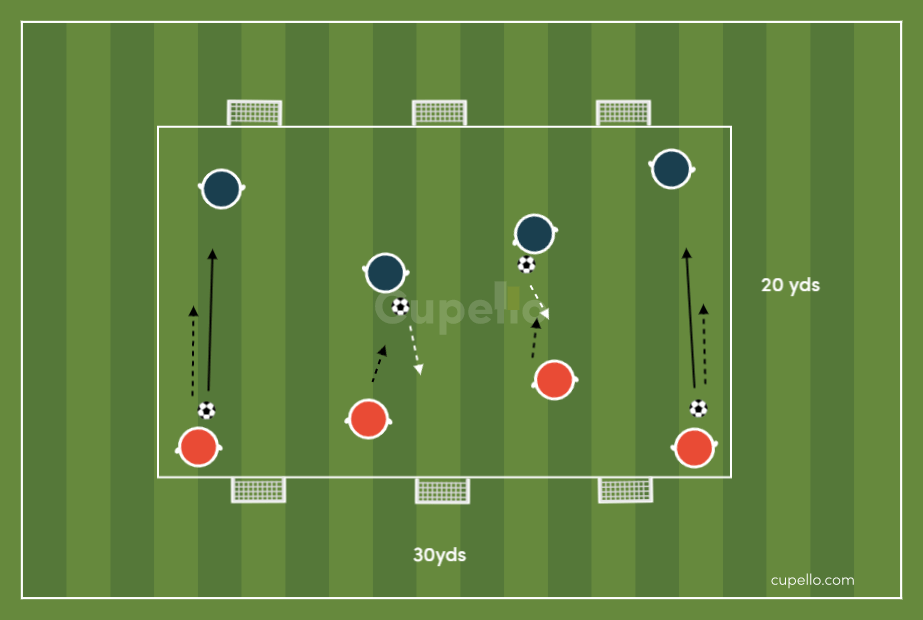
Dribbling at a defender and finishing. Use it in place of the 1v1 Gauntlet when you want a shot at the end.
Managing a group of 7-year-olds
Queues
If more than three children are standing in a line, the set-up is too big for one station. Split into more, smaller channels or give everyone a ball. Lines are where pushing and wandering start.
Signals and instructions
- Agree on one stop signal, such as "Freeze! Foot on the ball!", and practice it in the first five minutes.
- Gather players with the sun behind them, not in their eyes, and with balls under their feet or behind them.
- Show, don't explain. A 10-second demonstration beats a minute of talking.
- Use names. Praise something specific ("Maya, great job looking up before you turned") rather than "good job".
Water and toilet breaks
Plan a drink break between games, roughly every 12-15 minutes, and more often in hot weather. Use the break to set up the next game, so the children come back to it ready to go. Remind parents before the first session to send a named water bottle and to make sure children visit the bathroom before practice.
Parents
- Give them a job. Ask one or two parents to collect balls, watch a second field, or lay out cones. England Football's guidance for 3v3 matchdays uses parent "pitch facilitators" in a similar way.
- Ask for quiet cheering. Clapping and cheering is great; instructions from the sideline aren't. England Football's 3v3 guidance asks parents for "minimal input while the games are playing".
- Tell them the plan. A short message before the season ("We play lots of small games, everyone plays equal time, and we don't keep league tables") heads off most complaints.
What match format do 7-year-olds play?
It depends on where you are, and both the US and England changed things for 2026-27. Always check with your local league, as it sets the final rules.
United States
From the 2026-27 season, US Youth Soccer, US Club Soccer and AYSO group players by an August 1 to July 31 cut-off instead of birth year. U7 covers players born August 1, 2019 to July 31, 2020, and U8 covers August 1, 2018 to July 31, 2019, so a 7-year-old will be in U7 or U8 depending on their birthday.
U.S. Soccer's small-sided standards for U7 and U8 are:
- 4v4 with no goalkeepers
- Field 25-35 yards long and 15-25 yards wide
- Goals no larger than 4 feet high by 6 feet wide
- Size 3 ball
- Four quarters of no more than 10 minutes
- No offside and no penalty kicks; all free kicks indirect
- No heading: U.S. Soccer guidelines say players in U11 programs and younger shouldn't head the ball in practices or games
England
England Football's Future Fit changes came in at the start of the 2026-27 season. Age groups follow the school year, so 7-year-olds are in U7 or U8.
- U7: 3v3. No goalkeepers and no substitutes, so everyone plays all the time. Pitch 15 x 10 m (maximum 20 x 15 m), goals 4 ft x 2.5 ft, size 3 ball. Games last 6-10 minutes, with players rotating through several games for 30-40 minutes of playing time. Restarts are pass-ins or dribble-ins, there's a retreat line after goals, and there's no offside or heading.
- U8: 5v5 with goalkeepers. Size 3 ball, goals 12 ft x 6 ft, 40 minutes of match play, pass-ins or dribble-ins instead of throw-ins, a retreat line, and no heading.
- Transition year: teams that played 5v5 as U7s in 2025-26 carry on playing 5v5 as U8s this season.
A 3v3 game is effectively drill 10 above. Training with 3v3 and 4v4 every week gets players used to exactly what they'll face on matchday.
Drills for other ages
Coaching a younger or mixed group? Start with our soccer drills for 5 year olds and the 10 best U6 soccer drills. For the next step up, see U8 soccer drills and the 10 best U9 soccer drills, or browse every age group in our soccer drills hub.


Cupello
Rethinking soccer coaching via our industry leading tools. Built to offer effective coaching development solutions for players and coaches of all levels.